
1. Shoes on, stand tall
Use the shoes they will ride in. Stand upright against a wall with feet slightly apart on a flat floor.

Measure. Match. Ride.
A bike they can control today helps build confidence for tomorrow. Start with their leg inseam, then choose for how they ride.

Find Their Fit
Enter their inseam in riding shoes and choose their current riding stage.
A few minutes well spent
You need a firm book, a tape measure and their riding shoes.

Use the shoes they will ride in. Stand upright against a wall with feet slightly apart on a flat floor.

Hold a firm book snugly between their legs, with its top edge level. It should feel like sitting on a bike saddle; keep both feet flat.

Measure vertically from the floor to the top edge of the book. Record centimetres, repeat, and check any inconsistent readings.
Book-position and measurement illustration: Strider size guide. The standing-position photo is illustrative.
Make the differences clear
Select up to three bikes from your finder results to compare size, weight and pedal setup.
Select bikes in the finder to begin.
Check the rider, not just the chart
Inseam narrows the options. Check the child on the bike before deciding.
With the saddle adjusted for learning, they should be able to place both feet flat, bend their knees slightly and push along comfortably. They should reach the bars without stretching.
Choose a bike they can start, stop and control confidently. A first-time pedaller may need easier ground contact than an experienced rider. Check reach and brake operation wherever brakes are fitted.
Have a knowledgeable fitter check saddle position, comfortable knee bend through the pedal stroke, standover clearance and control. Follow saddle insertion limits and the model’s rider limit.
Confidence comes first
A larger wheel is not automatically a better next step.
If they stretch for the bars, cannot support the bike or struggle to stop, choose a more manageable option. Where ranges overlap, compare the whole bike and arrange a fit check.
A taller child can still benefit from learning balance before pedals. Choose a frame that fits their inseam and ability rather than assuming their age means they should already pedal.
One familiar bike, a new skill
Kidvelo Rookie 14, 18 and 24 convert from balance mode to pedals with the included kit.

Practise pushing, gliding and controlled stopping before adding another skill.

Progress when they can balance and steer confidently. Rookie 24 also has a two-speed automatic hub. Rookie 12 remains a dedicated balance bike.
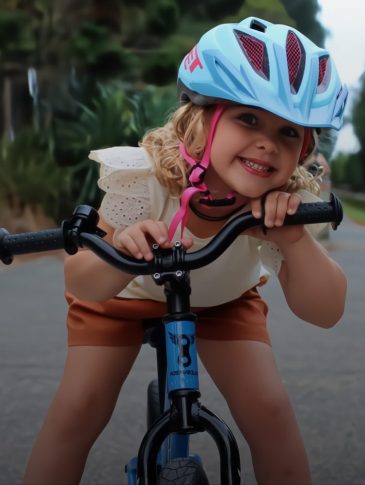
Model-by-model sizing
Wheel size describes the wheel, not the child’s fit. Use the exact model’s range.
| Model | Wheel | Inseam | Type | Pedal setup |
|---|---|---|---|---|
| Kidvelo Rookie 12 | 12″ | 30–46 cm | Balance | Balance only |
| Kidvelo Rookie 14 | 14″ | 40–58 cm | Convertible | Pedal kit included |
| Kidvelo Rookie 18 | 18″ | 48–68 cm | Convertible | Pedal kit included |
| Kidvelo Rookie 24 | 24″ | 62–84 cm | Convertible | Pedal kit included |
| Hornit AIRO 12 | 12″ | 30–46 cm | Balance | Balance only |
| Hornit AIRO 14 | 14″ | 40–53 cm | Balance | Balance only |
| Cruzee Ultralite 12 | 12″ | 28–46 cm | Balance | Balance only |
Your questions, answered
Practical answers before you choose.
Age is a rough starting point. Children of the same age have different inseams, confidence and strength. Measure first, then assess riding ability and on-bike control.
No. Measure the child directly using the book method above. Clothing labels are not a reliable bike-fit measurement.
Balance practice can help a child learn steering and gliding before adding pedals. Choose a learning approach that suits the child and a bike they can control.
Repeat the measurement in centimetres and check the selected riding stage. This is a curated model list. Contact us for help instead of rounding the measurement into a size.
Published ranges can overlap. Compare saddle adjustment, reach, weight and handling; do not automatically choose the larger bike.
Weight matters when lifting, steering and starting, but fit, braking, handling and suitability matter too. Compare complete bikes in the same balance or pedal configuration.
Ask a parent or carer to measure the child’s inseam and describe their riding ability. Share this page before choosing; age alone cannot confirm the size.
Let’s get the fit right
Tell us their inseam, current riding ability and the models you are considering. We can help you narrow the choice.
First timer?
Subscribe to your newsletter and be the first to hear about our new arrivals, special promotions and online exlusives